
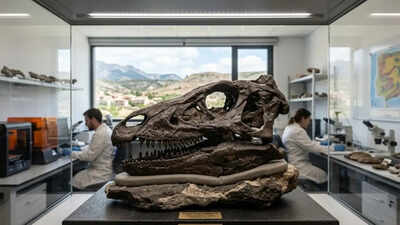
In Teruel, Spain, palaeontologists unearthed a nearly complete skull of the armoured dinosaur Dacentrurus armatus. This extraordinary find dates back 150 million years to the Late Jurassic period. The skull emerged from the Villarrubio Formation and stands as the most intact stegosaur skull ever found in Europe. Dinosaur skulls are often fragile, so they seldom fossilise, making this discovery crucial for understanding these ancient plant-eaters’ cranial structure. Published in the journal Vertebrate Zoology, the discovery has allowed researchers to formalise a new evolutionary group called ‘Neostegosauria.’ The breakthrough clarifies stegosaurs’ lineage on the Iberian Peninsula and offers fresh insights into how these iconic plated dinosaurs evolved across different continents long ago.
Rare dinosaur skull discovery in Spain is rewriting Jurassic history
The fossil was recovered at the ‘Están de Colón’ location in Riodeva, a place famous for its abundant paleontological discoveries. As noted in the journal Vertebrate Zoology, the skull is from a Dacentrurus armatus, a type of stegosaur known for its spiky armour instead of the dermal plates that its relative, the Stegosaurus, has. This finding is quite significant as a ‘paleontological milestone,’ mainly because it’s rare to find stegosaur skulls in Europe. Their bones are usually too thin and fragile to last long enough to become fossils.
3D modelling reveals hidden features of the Riodeva skull
Sergio Sánchez-Fenollosa and his research team used advanced 3D modelling and comparative anatomy techniques to discover previously unknown features in the Riodeva skull. With this new information, they formally defined the ‘Neostegosauria’ clade. This group includes two major families: Stegosauridae and Huayangosauridae. Surprisingly, the discovery shows that Dacentrurus had a much more complex evolutionary relationship with North American species than previously hypothesised.
How a fragile skull survived the Jurassic era
In the Villarr del Arzobispo Formation, scientists discovered a skull. According to the journal Vertebrate Zoology, this formation dates back around 150 million years, covering the Kimmeridgian-Tithonian boundary. It reconstructs an environment of coastal areas filled with deltas and lagoons where mega-herbivores once inhabited. Finding such a fragile skull here sheds light on how fossils formed in the Iberian Peninsula during the Jurassic era.
