
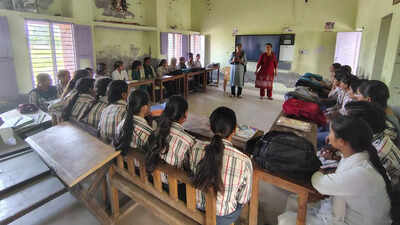
A recent social experiment conducted at Glendale International School has thrown up an interesting disconnect in how learning is perceived inside classrooms versus at home. While schools increasingly talk about “holistic development,” the data suggests that students may already be experiencing that shift more than adults realize.Across Grades 1 to 9, the school tracked behavioural patterns alongside academic learning and found that a majority of students are consistently demonstrating life skills such as self-management, initiative, and collaboration. The findings were part of a broader exercise to understand what children believe they are learning compared to what parents assume they are learning.What the experiment actually looked atThe exercise wasn’t a test in the traditional sense. Instead, it used structured behavioural rubrics to observe everyday classroom behaviour—how students manage tasks, respond to peers, take initiative, or regulate their own learning without reminders.These observations were integrated into the school’s ongoing learning framework under its Leader in Me programme, which draws on habit-building principles inspired by widely used leadership and personal effectiveness models.The idea was simple: move beyond marks and ask a different question—what skills are actually showing up in day-to-day school life?The perception gap: Parents vs studentsOne of the most striking outcomes came from a parallel survey-style question posed separately to parents and students: “What is your child learning well in school?”Parents largely pointed to academic subjects—math, science, languages, exam performance. Students, however, answered differently. They highlighted responsibility, listening, collaboration, initiative, and self-management.That mismatch suggests a familiar but often overlooked gap: adults tend to evaluate learning through measurable academic outputs, while children often experience school as a mix of academic and behavioural growth happening at the same time.The numbers behind student behaviourThe internal observations revealed some clear patterns across the student group:• 84% of students demonstrated self-management without external prompts• 80% showed proactive behaviour and initiative• 80% consistently prioritised collaborative thinking over individual focus (“we over me”)• 79% were able to prioritise tasks without reminders• 65% demonstrated empathetic listening skills• 52% showed the ability to independently plan aheadTaken together, the data points toward a learning environment where behavioural skills are not incidental—they are consistently visible in classroom interactions.Inside the ‘habit-based’ learning frameworkThe school attributes these outcomes to its structured use of the Leader in Me programme, which integrates behavioural development into everyday classroom practice rather than treating it as an extracurricular layer.In practice, this means habits like accountability, empathy, initiative, and collaboration are embedded into how students are asked to work—group tasks, independent assignments, peer interaction, and self-review processes.The behavioural tracking system is designed to make these “soft skills” observable, even if they are harder to quantify than test scores.What educators say the findings point toAccording to Mr. Atul Temurnikar, Chairman of Global Schools Group, the results highlight a broader shift in how student development is being understood.“This initiative reflects a shift from focusing only on performance to understanding student development more holistically. By embedding habit-building into everyday learning, we are helping students build capabilities that extend far beyond the classroom,” he said.Ms. Minu Salooja, Director at Glendale International School, noted that many of these behaviours already exist in classrooms but are often not formally recognised.“Education has long been defined by what is easy to measure—marks, ranks, and results. But what truly drives outcomes are behaviours that are far less visible,” she said. “Habits like listening, ownership, and initiative shape how children perform over time.”
