



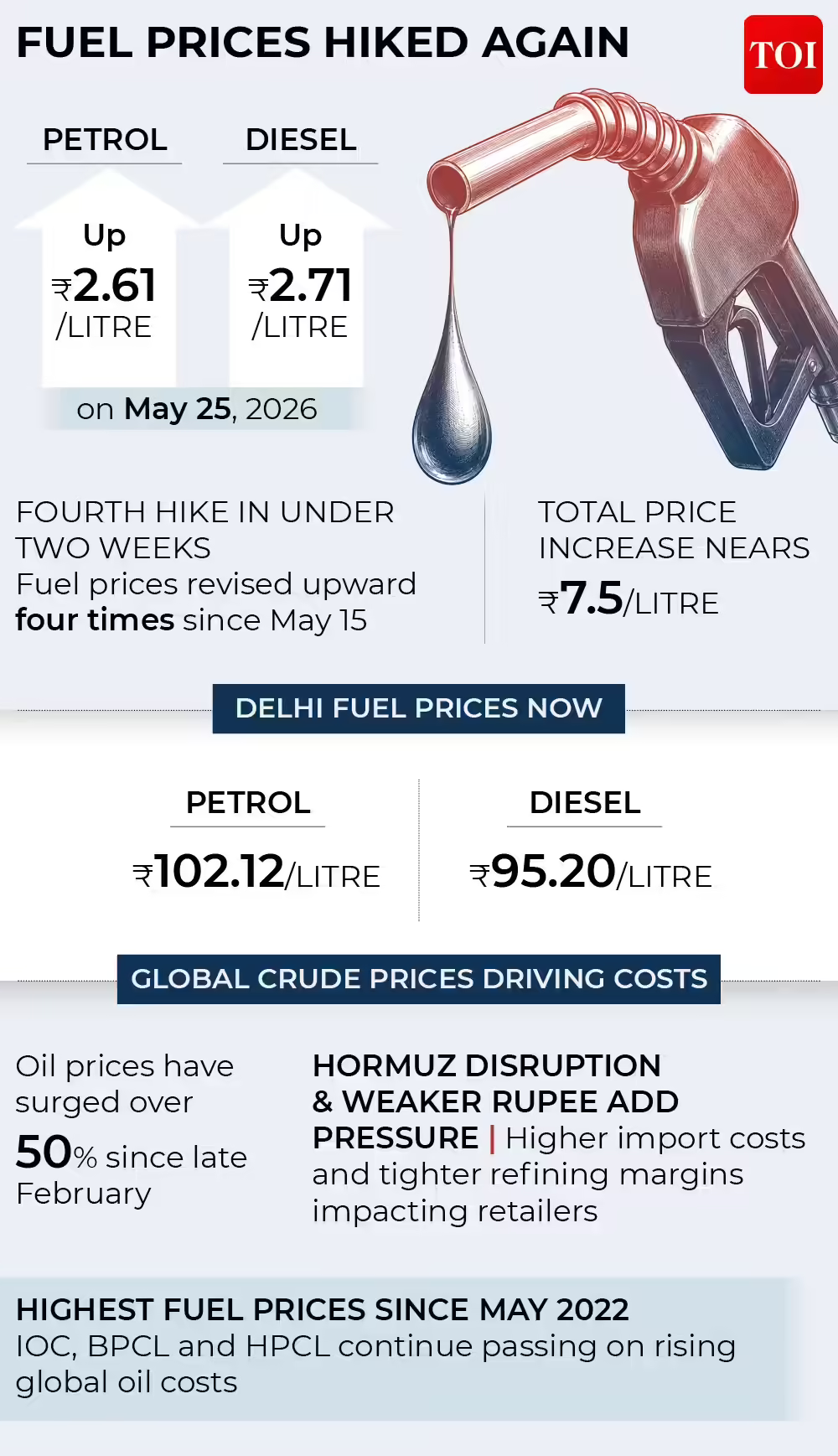
Your next trip to the fuel station just got more expensive!Fuel prices across the nation saw another revision, now becoming costlier by Rs 7.5 per litre since the Middle East crisis began. Early Monday, petrol prices were hiked by Rs 2.61 per litre, while diesel prices were increased by Rs 2.71, marking the fourth increase in just ten days.These back-to-back revisions are now raising concerns over a ripple effect on household budgets, inflationary pressures, and everyday commuting costs, leaving consumers to quietly do the math all over again.The latest round of price hikes comes against the backdrop of the ongoing conflict in the Middle East, which has tightened global energy supplies. With crude shipments under pressure and geopolitical tensions showing little sign of easing, international oil prices have been trending higher, with the impact steadily filtering into domestic retail markets.Retail fuel prices had remained largely unchanged for nearly four years before the first hike on May 15, making the sharp, fortnight-long surge in prices all the more striking.Prices continue to vary across states due to differing local taxes.


Impact of rising petrol and diesel prices
Impact on transportation
Transportation is the first and most direct sector to feel the impact of petrol and diesel price hikes. Your drive to the office, that weekend road trip, and quick grocery run — everything will now cost slightly more. With the latest increase, transporters are under significant operational pressure after four rapid fuel revisions. Fuel alone accounts for more than half of truck operating costs, and when added to rising expenses such as tires, insurance, tolls, maintenance, finance costs and statutory compliances, transport operations are now facing severe pressure on viability.“Fuel alone accounts for nearly 55% of truck operating costs. Along with increasing costs of tyres, insurance, tolls, maintenance, finance costs and statutory compliances, the viability of transport operations is under severe pressure,” one transporter told TOI.Transporters also argue that instead of repeated smaller hikes, a single transparent fuel pricing decision would allow better planning of freight structures and business viability.
Supply chains and deliveries
Rising fuel prices are also creating wider pressure across supply chains and delivery networks in the country. Logistics operations are under strain, with transporters already raising freight charges, a move that is expected to increase the cost of delivered goods, including essential items. At the same time, higher operating costs are affecting delivery schedules, reducing overall efficiency in supply chains and last-mile distribution systems.In several regions, reports suggest that a large number of vehicles are being kept idle as operating costs and challenges continue to rise, leading to estimated losses of nearly Rs 3,500 per vehicle per day in some sectors. The ripple effect is already visible, with disruptions in vehicle movement, pressure on supply chains, delayed deliveries, and growing strain on manufacturing, import-export activity, and the movement of essential commodities.
Household bills go up
Rising petrol and diesel prices are set to squeeze household budgets, making everyday expenses, from food delivery and groceries to dining out, more expensive. As fuel costs climb, transport-linked expenses across essential goods are also rising, adding to the burden on consumers and pushing up overall living costs. The impact is expected to deepen further, with inflationary pressures building across the economy. Your daily consumption basket: including staples, packaged foods and other essentials could get costlier in the months ahead as higher fuel prices feed into supply chain and input costs. The latest fuel price revision, amid ongoing Middle East tensions, is also likely to pressure FMCG companies, which may be left with limited options such as selective price hikes or reductions in product grammage, according to industry executives. Freight costs are set to increase distribution and input costs, further straining margins of companies already grappling with 8-10% inflation.“If fuel prices remain elevated over multiple quarters, companies may eventually resort to calibrated price hikes or grammage reductions, which could weigh on consumption recovery, particularly in price-sensitive rural markets’’ Naveen Malpani, partner and consumer & retail industry leader, Grant Thornton Bharat had told TOI.FMCG companies like Nestle, Hindustan Unilever, Marico and Dabur have seen demand recovery but are facing rising input costs and inflation pressures. To offset this, they have already taken 2–5% price hikes and may consider further increases along with cost-cutting measures.
Impact on economy
Finance minister Nirmala Sitharaman on Monday assured that India’s economy continues to show resilience on a broader note. “We should appreciate that the challenges are more externally driven. We must also recognise that India’s domestic economic situation remains positive and resilient even today,” the FM said.

At the same time, rising fuel prices have raised concerns about creating wider economic pressure as transportation costs feed into supply chains. This is increasing the cost of essentials, including fruits and vegetables, and adding inflationary pressure across sectors. The movement of goods, manufacturing activity, and import-export operations are all experiencing stress due to higher logistics costs and delivery disruptions.
OMC shares soar
Fuel price revisions have also influenced market activity. Shares of major oil marketing companies moved higher on Monday, with Hindustan Petroleum Corporation Limited (HPCL), Indian Oil Corporation (IOC), and Bharat Petroleum Corporation Limited (BPCL) all soared in green.IOC shares rose 4% to Rs 145, HPCL surged 6% to Rs 412.55, and BPCL advanced over 4.5% to Rs 309 on the BSE. The movement came as crude oil prices touched a two-week low amid signs of progress in US-Iran peace talks.Meanwhile, before the recent price hike, the government had been stepping in to help oil marketing companies (OMCs) manage the pressure from rising crude prices by cutting excise duties. Now, the FM highlighted, any reduction in excise duty on petrol and diesel would result in a revenue impact of around Rs 1 lakh crore.
What’s ahead for OMCs?
Earlier, in the absence of price hikes, oil marketing companies (OMCs) were facing heavy losses of up to Rs 1,000 crore per day. Now, with fuel prices rising by nearly Rs 7 per litre, the question is whether these losses will be reduced or not.The recent series of back-to-back price increases is expected to provide some relief to OMCs, but it is unlikely to fully offset their burden. Even if the situation in West Asia stabilises, uncertainty around the Strait of Hormuz is expected to persist for some time, keeping crude prices elevated, likely above $90 per barrel.At the same time, a weakening rupee continues to add pressure on margins. “Combined with a weakening rupee, this continues to pressure OMC margins, and they could still face under-recoveries. Going forward, some calibrated price revisions may be required. The government will need to balance OMC financial health against the impact on consumers,” Sourav Mitra, Partner – Oil and Gas, Grant Thornton Bharat told TOI.


3 F’s in focus
Finance minister Nirmala Sitharaman has also urged the country to focus on the 3 Fs, of fuel, fertiliser and forex. Apart from elevated crude oil prices, fertiliser costs have also surged to “unimaginable” levels, the FM noted, adding that high gold prices are creating additional challenges on the external front. She emphasised the need to focus on the “three Fs,” fuel, fertiliser and forex, pointing out that Prime Minister Narendra Modi’s recent appeals have been made in this context.Taken together, the latest fuel price revisions are no longer just a heavier cost at the petrol pump, they are beginning to ripple through daily lives. From transporters recalibrating freight rates and supply chains under strain, to households quietly tightening monthly budgets, the impact is gradually seeping into everyday life. With global crude trends still uncertain and geopolitical tensions far from settled, the outlook for fuel prices remains closely tied to developments far beyond domestic borders.