



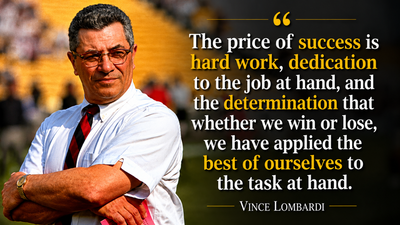
On the morning of June 11, 1913, in Brooklyn, New York, a boy was born into a household that did not have much patience for shortcuts. His father was an Italian immigrant who ran a butcher shop, and from an early age, Vince Lombardi was expected to work in it, hauling, cleaning, serving, doing the unglamorous physical labour that kept the business running. It was not the kind of childhood that produced entitlement, and by most accounts it was not meant to. The Lombardi home was Catholic, disciplined and serious about education, and the values that shaped it, effort, commitment, accountability, stayed with Vince for the rest of his life. He would go on to become the most celebrated coach in American football history, the man whose name now appears on the trophy awarded to every Super Bowl champion. But that destination was neither obvious nor quick in coming, and the road between a Brooklyn butcher shop and five NFL Championships is worth following carefully, because it is the most honest illustration available of the philosophy he eventually put into words: “The price of success is hard work, dedication to the job at hand, and the determination that whether we win or lose, we have applied the best of ourselves to the task at hand.”
Brooklyn to the Blackboard: The Making of a Coach
Lombardi’s first serious ambition was not football. After high school, he enrolled at Cathedral College Preparatory Seminary, genuinely considering the priesthood. Sport eventually pulled harder, and he transferred to Fordham University on a football scholarship, where he became part of the offensive line known as the ‘Seven Blocks of Granite‘ a unit recognised across college football for its toughness and technical discipline. He was not the most naturally gifted player on that line, but he was among the most committed, and he played both offense and defence with the kind of total application that would later define everything he asked of others. After graduating, Lombardi spent several years drifting between business, law and chemistry, none of which held him. The clarity came in 1939 when he accepted a position at St. Cecilia High School in New Jersey, teaching physics, chemistry, Latin and general science while simultaneously coaching football, basketball and baseball. He was twenty-six years old and responsible for more subjects and sports than most people would consider manageable, but these eight years at St. Cecilia’s were where his coaching identity was built. He broke the game down into its smallest components, drilled execution obsessively and held his players to standards they had not previously been asked to meet. His teams won consistently. His methods were demanding enough to intimidate and respected enough to work. From St. Cecilia’s he moved to Fordham as an assistant, then to West Point in 1949 under the legendary Earl Blaik, where he spent five years absorbing the culture of a military institution, precision, hierarchy, preparation, the idea that performance under pressure was a direct product of how seriously you had prepared when no one was watching. In 1954 he joined the New York Giants as offensive coordinator, helped rebuild the franchise, developed Frank Gifford into one of the league’s most dangerous weapons and guided the team to the 1956 NFL Championship. He was by then one of the most respected offensive minds in professional football, and he was forty years old, still waiting for a head coaching opportunity.
Green Bay and the Price He Asked Everyone to Pay
The call came in 1959, and it had taken longer to arrive than it should have. Despite his reputation as one of the sharpest offensive minds in professional football, Lombardi had spent years at the Giants without a serious head coaching offer materialising. He had considered leaving football altogether. When Green Bay finally came, he was forty-five years old and taking over a franchise that had finished 1-10-1 the previous season and had not had a winning record in over a decade. He arrived as head coach and general manager and walked into his first team meeting carrying a standard his players had not yet been introduced to. He told them he had never coached a losing team and had no intention of starting. He told them he was looking for thirty-six men with the pride to make any sacrifice to win, and that anyone unwilling to meet that standard would be replaced. He later confided to the veteran receiver Max McGee that he had half-expected the entire room to stand up and walk out. They didn’t, and what Lombardi built over the following nine seasons became the benchmark against which NFL success is still measured. The methods were specific and uncompromising. The Packers’ famous power sweep; their signature running play, was practised so repeatedly that every player’s assignment became automatic regardless of weather, scoreline or fatigue. Lombardi believed that people in pressure situations perform to the level of their preparation, not their desire, and he structured every practice week accordingly. Off the field, players wore blazers and ties on road trips. Curfews were enforced. The idea that you represented the organisation at all times, not only during the sixty minutes of a game, was not a suggestion. Five NFL Championships followed. Two Super Bowl victories. Not a single losing season across nine years. After Super Bowl II in January 1968, the wear showed. Lombardi had driven himself and his players through nine seasons at that standard, and the physical and emotional toll was visible enough that he stepped back from coaching and moved into a purely administrative role with the Packers. The break lasted a year. In 1969, he returned to the sideline as head coach, general manager and part-owner of the Washington Redskins, another struggling franchise, and once again he improved them almost immediately, guiding the team to one of its best records in years. It was the same process, applied to a different set of players in a different city, the same preparation, the same standards, the same daily insistence on effort over comfort. He never got to see where it led. Diagnosed with colon cancer in the summer of 1970, Lombardi died on September 3rd of that year, aged fifty-seven, less than two seasons into what would have been his final chapter.
What the Quote Actually Means, And How It Works Outside Sport
The quote Lombardi left behind is not motivational decoration. It is a description of a transaction he understood from experience, the exchange between consistent effort and eventual result, and the recognition that the result is not always within your control but the effort always is. The student preparing for a major exam lives inside this transaction whether they recognise it or not. Dedication to the job at hand, in Lombardi’s terms, means ignoring the phone and working through one difficult concept at a time, not because the grade is guaranteed but because the discipline built during those hours is the actual preparation, and without it the grade, if it comes, is fragile. The success is not just the result on the paper. It is the work done in the weeks before it. In a professional context, hard work most often looks like consistency rather than dramatic effort, the employee who stays late not because they were instructed to but because they refused to submit work that was merely acceptable, who turned a routine report into something genuinely useful because they applied more than the minimum to it. That kind of commitment builds a professional reputation that outlasts any individual win or loss, and it is built one ordinary task at a time, which is precisely what Lombardi meant by dedication to the job at hand. The most significant part of the quote, though, is the final clause, “whether we win or lose, we have applied the best of ourselves.” This is where Lombardi’s philosophy separates itself from simple outcome-chasing. A business venture can fail due to market conditions entirely outside your control. A student can prepare thoroughly and still encounter an exam that does not reflect their preparation. Lombardi’s point is that if the effort was genuine and complete, the failure does not undo it. The work ethic, the discipline, the habits built through that effort, those remain, and they carry forward into whatever comes next. What he is describing is not consolation. It is a practical understanding of what you actually control, and the decision to pour everything into that rather than into the outcome, which you do not. He lived it in that order. Brooklyn, the butcher shop, the seminary, Fordham, eight years teaching high school, West Point, the Giants, the long wait, and then finally Green Bay, where the results arrived because the preparation had already been paid for, across decades, long before anyone was watching. And then Washington, at fifty-five years old, starting again, because for Lombardi the alternative to applying your best was never really an option he considered.