
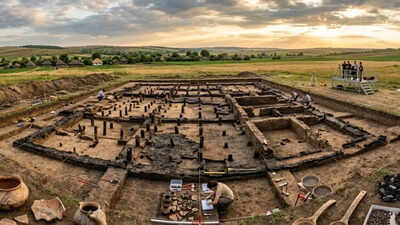
In Botoșani County, Romania, a team of archaeologists uncovered a monumental mega-structure dating back 6,000 years. This discovery challenges our basic ideas about how human societies developed. According to a study published on PLOS One, the structure, associated with the Cucuteni-Trypillia culture from around 4000 to 3900 BC, covers about 350 square meters. That’s almost four times bigger than the standard domestic dwellings from that period. Unlike grand monuments of later times, this site doesn’t show signs of elite wealth or a central leader. It suggests that prehistoric Europeans carried out large engineering projects through community efforts rather than orders from rulers. Located at the Stăuceni-’Holm’, this finding is changing how we think about prehistoric Europe. It proves that complex architecture can exist without a complicated stratified social hierarchy.
Scientists stunned by giant 6,000-year-old structure hidden in Romania
The structure known as ‘Building 43’ stands out as an unusual architectural feature from the Late Chalcolithic period, specifically during the Cucuteni B1 stage. It measures around 13 by 27 meters, covering nearly 350 square meters in total, as noted in a study published on PLOS One. Research indicates that people used a sophisticated timber-frame technique and large quantities of clay (daub) to construct it. The building material required-hundreds of tons of clay and timber-suggests that the community put in a significant collective effort, much greater than what was needed for typical houses in the settlement.
Why did the Cucuteni-Trypillia culture burn their houses
The research team carried out geomagnetic surveys and micro-morphological analysis. They discovered that the mega-structure was partitioned into internal compartments. A key finding is the evidence of ‘intentional firing.’ Building 43, like many other structures from the Cucuteni-Trypillia culture, was intentionally burned at the end of its use. The scientists found that some areas reached temperatures exceeding 800 degree Celcius. This indicates that the burning was likely a planned ritual, not an accident or an act of war.
Researchers discovered Henbane and Poppy seeds
Digging inside the footprint and foundation levels revealed some rare pottery. Among them were a zoomorphic vessel and intricately designed ladles. More importantly, researchers discovered burnt seeds of Black Henbane and Opium poppy through detailed analysis. The finding of these psychoactive botanical remains in a large communal area suggests that the structure functioned as a ‘Social Centre’ or ‘Ritual Hub.’ Here, people likely gathered for shared experiences that might have involved altered states of consciousness.
No luxury items found
The study published on PLOS One highlights an interesting point about the site’s equality. Even though the building is huge, there aren’t any luxury items like gold, copper, or rare imports that you’d expect in a king’s or chief’s home. This information indicates that the people of Stăuceni operated as a sophisticated society without one leader in charge. The massive structure served as a ‘community hub,’ showing that ancient Europeans could achieve impressive engineering feats by working together socially, rather than under coercive authority.
