

NEW DELHI: While rejecting the US Trade Representative’s claims for section 301 investigations against India, govt has said that concerns should be addressed bilaterally, when negotiations for a trade agreement are underway, and not through unilateral measures.After the setback on reciprocal tariffs in the Supreme Court, the Trump administration had initiated two section 301 probes — one on structural excess capacity and another on failure to act on forced labour — against several countries, including India.
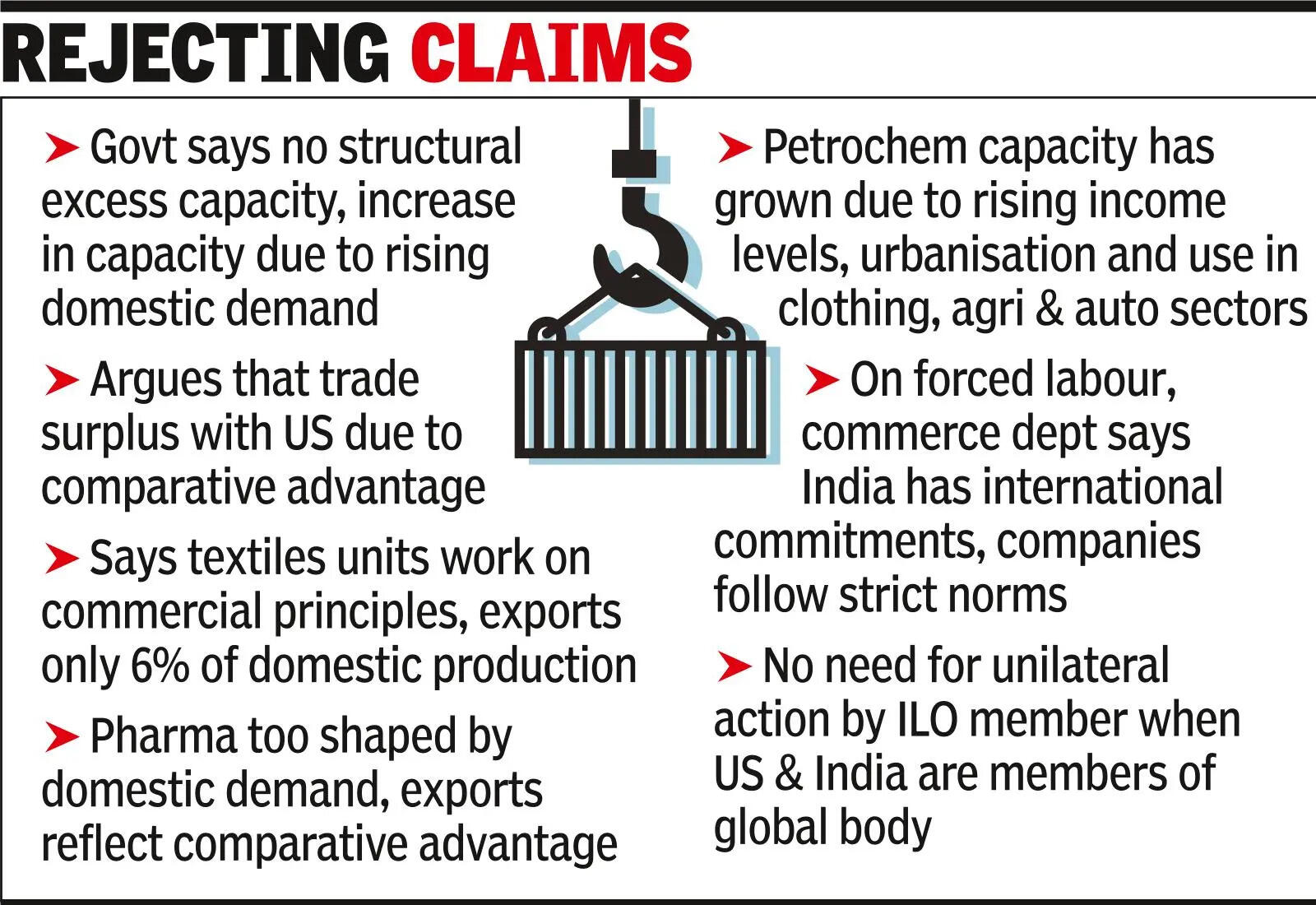
An Indian team led by chief negotiator Darpan Jain will hold talks with their American counterparts in Washington, starting Monday. “We are looking at finalising the legal agreement, which is a logical follow-up of the joint statement released on Feb 7. There is a need for further discussions and follow-up engagement to take this forward. The US has initiated investigations involving several countries. Both sides will sit together and discuss how these issues need to be structured and addressed,” commerce secretary Rajesh Agrawal said.In its filing on forced labour, the commerce department has said that it has international commitments on the subject and given the International Labour Organisation’s “robust” framework, there is no need for a member of the international agency to “unilaterally” initiate a probe. It also argued that the US labour department’s list of goods produced by child or forced labour has limited exposure to downstream goods produced in India.It also rebutted the claims across sectors, listing out the norms governing handicrafts, leather, carpet and gems and jewellery. In the case of textiles, govt has said that apart from the robust legal and compliance ecosystem, India entities have not relied on cotton imports from high-risk regions, such as Xinjiang and import of man-made fibres or accessories from countries are buyer driven and subject to strict compliance verification by global brands.Similarly, govt has countered allegations of structural excess capacity arguing that increase in nominal capacity is in line with projected rise in demand.It also junked the charge of $42 billion trade surplus with the US being due to overproduction or excess capacity stating that it “is a macroeconomic phenomenon which is a product of a concatenation of circumstance”. It went on to say: “… the initiation notice is effectively challenging the foundational principles of comparative advantage that underpin international commerce”.It argued that capacity created in sectors including solar modules, textiles, petrochem, health, auto and construction goods was on account of domestic demand. “Across industries specified in the initiation notice, India’s manufacturing growth is anchored in domestic demand. More crucially, USTR’s selective focus on specific sectors, in which India happens to have a global trade surplus, does not automatically establish that India has ‘structural excess capacity’ in some of the indicated sectors.”
