
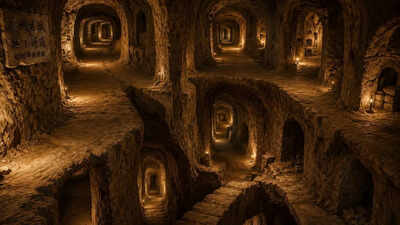
A huge ancient stone city buried for thousands of years in northern China has just become even more mysterious. Archaeologists working at the Houchengzui Stone City in Inner Mongolia have uncovered a hidden underground tunnel network dating back roughly 4,300 to 4,500 years. The tunnels were reportedly hidden beneath one of the largest and most heavily defended early stone cities ever found in the region. At first glance, the site already looked impressive enough with massive walls, defensive gates, and layers of protection everywhere. Then researchers discovered something underneath it all.Experts say the tunnels may have been used for both defence and movement inside the city, which raises all kinds of questions about how advanced these early communities really were. Some of the passages are still remarkably intact. You can apparently still see tool marks carved into the walls, which feels strangely personal considering the tunnels were dug more than four millennia ago.
Ancient underground tunnels discovered beneath China’s massive stone city
The Houchengzui Stone City sits on the north bank of the Hun River in Qingshuihe County, inside China’s Inner Mongolia Autonomous Region. The archaeological site covers around 1.38 million square metres, making it enormous by ancient standards.According to Archaeology Magazine, researchers from the Institute of Archaeology at the Chinese Academy of Social Sciences, alongside regional archaeology teams, have spent the last five years excavating the area. Their work has slowly revealed what appears to be an extremely organised settlement from the Longshan period.The city itself has an oval or elliptical shape. It stretches around 1,200 metres long and about 1,150 metres wide. That alone is impressive for something built over 4,000 years ago. Still, it’s the defensive design that seems to have caught archaeologists off guard.The settlement included an inner city, an outer city, fortified gatehouses, terraces, walls, and moats. Multiple layers. Almost like the people living there expected conflict.
Mysterious underground tunnels reveal how the ancient city may have survived attacks
The newest excavation uncovered six intersecting underground tunnels beneath the city. Researchers say the passages spread outward from the city centre in a radial pattern, almost like spokes on a wheel. The tunnels sit between 1.5 and 6 metres underground. Most measure around 1 to 2 metres high and about 1.5 metres wide, just enough space for people to move through carefully.Archaeologists believe the tunnel system served more than one purpose. It might have allowed defenders to move secretly beneath the city during attacks. Some experts also suggest the passages worked as hidden transport routes or emergency escape corridors.The ceilings reportedly resemble cave-style architecture linked to the Longshan culture. Arched and carefully shaped. Not rough holes dug in panic. These tunnels appear deliberate and engineered.
Ancient city hints at powerful rulers and organised society
One of the biggest questions surrounding Houchengzui Stone City is what kind of society could actually build something this complex over 4,000 years ago. Experts say the site points to a surprisingly advanced level of planning and labour organisation. Constructing massive walls is difficult enough. Adding layered defence systems and underground tunnel networks suggests strong leadership and specialised workers may already have existed in the region.The city’s strategic position near the Hun River also appears important. Water access mattered enormously in ancient settlements, especially in northern China’s harsher environments.Some archaeologists believe Houchengzui may have acted as a regional power centre or military stronghold during the late Neolithic period. Others think it could have been a cultural hub connected to nearby communities through trade and alliances.
Ancient underground tunnels continue to puzzle researchers
The discovery of the ancient underground tunnels in China has already sparked fresh interest among historians and archaeologists. Yet many sections of the site remain unexplored.Researchers are still uncovering high-level buildings, burial areas, and architectural remains across the settlement. More tunnels could still be hidden underground. There’s also curiosity about how these tunnels were actually used during daily life. Were they mainly military structures? Right now, experts can only piece together clues from the layout and construction style.The visible tool marks inside the tunnels add another layer of intrigue. They are tiny reminders that real people carved these spaces out by hand thousands of years ago, likely with simple stone tools and incredible patience.
