
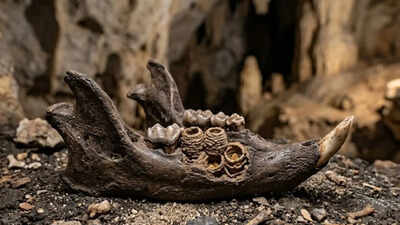
A fascinating study uncovered a unique behaviour in ancient insects. Dating back to the Late Pleistocene, solitary bees used the bones of extinct mammals to create homes for their young. Researchers from the Florida Museum of Natural History were digging in late Quaternary cave deposits in the Dominican Republic, expecting to find typical dental remains in the jawbones of extinct rodents, as noted in a study published in the Royal Society Publishing. Surprisingly, CT scans showed that these bones contained intricate mud nests instead. These structures have been identified as a new trace fossil called Osnidum almontei. This is the first time anyone has documented bees using unaltered vertebrate remains as nesting spots. Such an adaptation highlights how these bees survived in resource-poor and limestone-rich landscapes of ancient Hispaniola.
Archaeologists expected fossil teeth, but they were bee nests
According to the study published in the Royal Society Publishing, in the Pedernales Province of the Dominican Republic, researchers identified something intriguing in Cueva de Mono, a limestone cave. As they dug through sediment from the Late Quaternary period, they found bones of Plagiodontia araeum, an extinct type of rodent known as Hutia. The jawbones held a surprise: instead of the ambient cave sediment filling the tooth sockets, there were distinctly mineralised biogenic structures. At first glance, these looked like regular fossilised teeth. However, a closer look revealed them as intricate bee nests crafted inside the bone’s hollows.
Scans reveal the hidden blueprints of ancient architects
The researchers, through high-resolution μCT scans, discovered a new ichnospecies, Osnidum almontei. These trace fossils reveal nests with a ‘Russian doll’ or nested-cup structure. The bees cleverly utilised rodent mandibular alveoli as protective outer layers for their homes. Inside these shells, they crafted several stacked, barrel-shaped brood cells. To construct these cells, the bees gathered soil and sediment from nearby areas and used biological secretions to bind them into a material that resembled ceramic once hardened.
How bees protect larvae from cave humidity
The study published in the Royal Society Publishing shows that these solitary bees exhibited high nesting site fidelity. They kept coming back to the same fossilised bones over many generations. Inside the nests, scientists made some interesting discoveries as they found:
- A smooth, hydrophobic (water-repellent) lining on the inner walls of the cells, likely produced by the bees’ Dufour’s gland, to protect larvae from cave humidity.
- Clusters of pollen grains were found preserved within the brood cells, identifying the specific ancient flora the bees collected to feed their larvae.
- Some rodent jawbones contained up to six distinct nesting events within a single tooth socket.
Bees swapped soil for fossil cavities
The researchers found that this behaviour developed as a way to cope with the limestone landscape of Hispaniola. In these areas, locating soft soil deep enough for regular ground burrowing poses a challenge. However, the bees exploited natural cavities in vertebrate fossils located on cave silt floors, giving them a safe and stable environment with climate control. This marks the first recorded instance of insects using the dental cavities of vertebrate fossils as a nesting site.
