

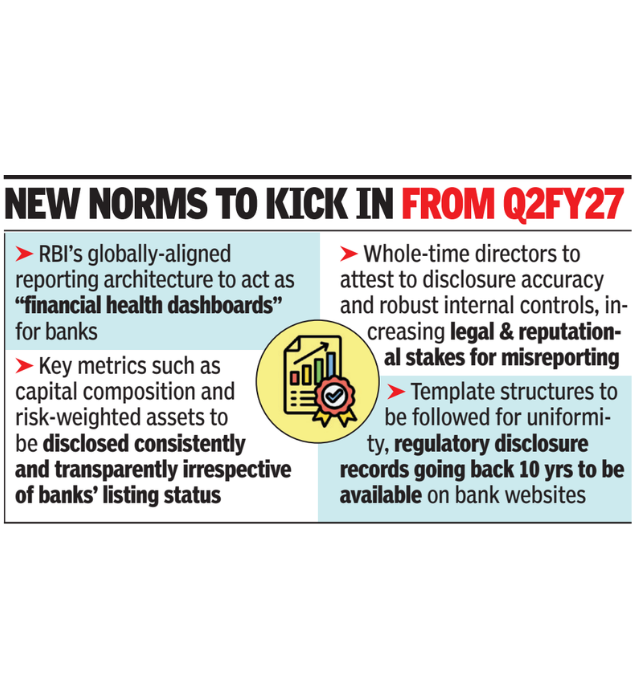
MUMBAI: RBI’s new disclosure norms will put unlisted banks at par with listed peers, standardise reporting formats and units, and make global comparisons of Indian lenders much easier by mandating uniform, template-driven disclosures.The new norms prescribe globally aligned reporting architecture that mirrors Basel standards, addressing the third of the three pillars of the globally accepted Basel Accord Framework. RBI has invited comments on the draft “Reserve Bank of India (Capital Adequacy) Amendment Directions, 2026” by June 2, 2026. The new norms will formally take effect from the second quarter of FY 2026-27.Instead of dense textual explanations embedded in annual reports, banks will now be required to publish clearly defined templates such as those for key metrics, capital composition and risk-weighted assets, enabling analysts and depositors to assess financial strength at a glance.
.
Hitherto smaller or unlisted institutions faced relatively lighter public disclosure requirements, the proposed rules ensure that all banks expose their capital position and risk profile in a consistent and transparent manner regardless of their listing status.The draft norms also introduce stronger accountability by requiring whole-time directors to formally attest to the accuracy of disclosures and the robustness of internal controls governing them. This elevates disclosures from being just a compliance exercise to a board-level responsibility.To improve clarity and eliminate inconsistencies, the RBI has proposed strict standardisation rules, including mandatory reporting of all figures in crores and a prohibition on altering template structures. Even where a particular disclosure item is not applicable, banks must retain the row and indicate its absence rather than removing it, ensuring that the visual layout remains identical across institutions and time periods.Further, banks will be required to maintain a dedicated regulatory disclosure section on their websites, with archives of such disclosures preserved for at least ten years. This creates a long-term digital trail of financial data, enabling stakeholders to track how a bank’s risk profile evolves across economic cycles and preventing the disappearance of historical information.
