

Mumbai: The RBI has dealt a blow to Tata Sons’ bid to avoid going public, rejecting an argument that would have allowed the Tata conglomerate’s holdco to surrender its financial licence and evade a mandatory stock exchange listing. In directions published on Wednesday, RBI clarified that equity received from group companies with access to capital markets counts as indirect access to public funds, explicitly dismissing suggestions for a narrower interpretation. The rules take effect on July 1.The ruling strikes at the heart of Tata Sons’ March 2024 application to deregister as a core investment company, a category of NBFC through which large conglomerates hold stakes in group companies. That application rested on the assertion that Tata Sons does not access public funds, having prepaid its standalone debt. The RBI’s clarification renders that claim untenable, legal experts say, given that its operating arms, including Tata Steel, Tata Power, and Tata Chemicals accessed debt markets when providing funds to the holding company.
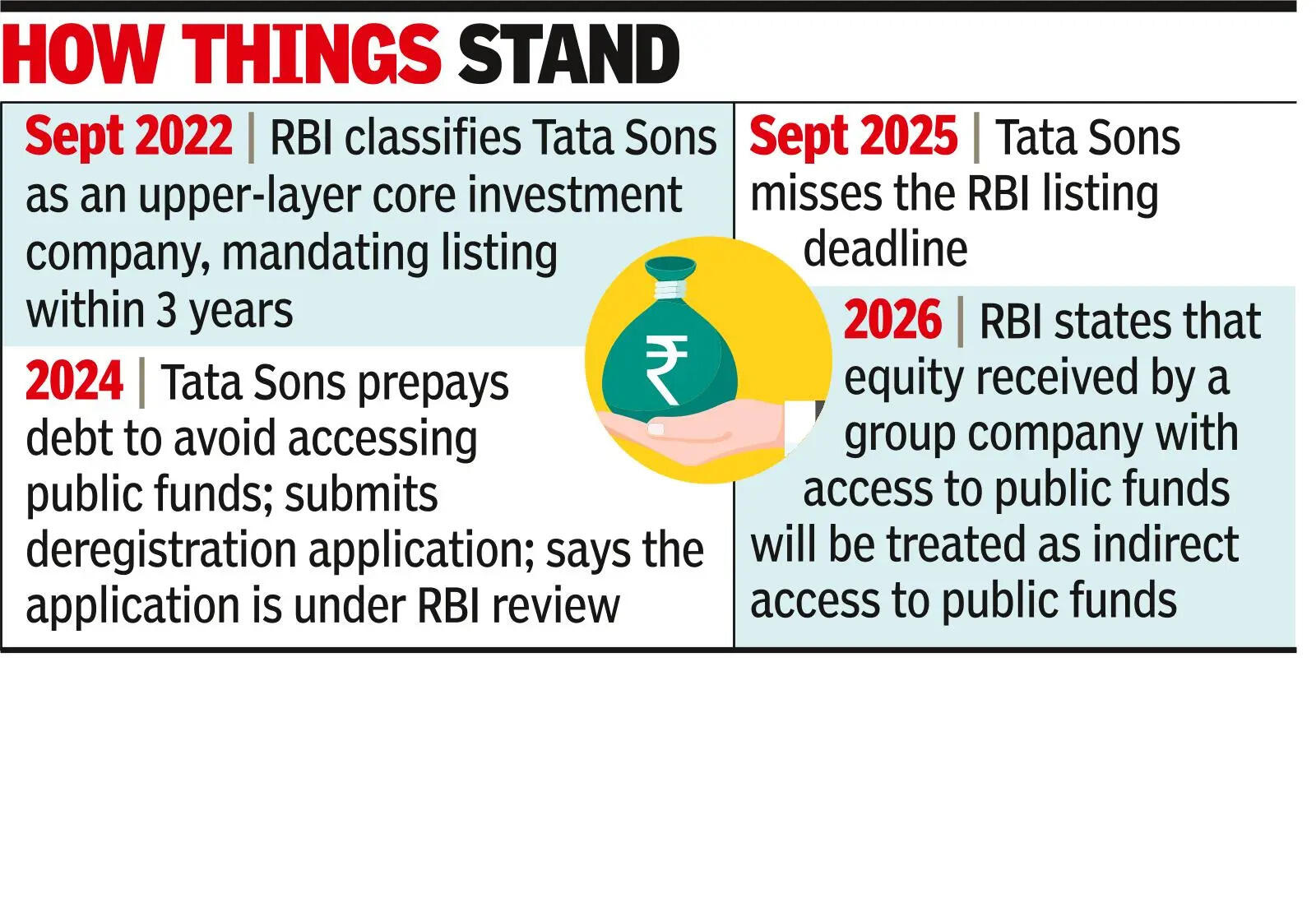
How things stand
It was argued that equity injected by a group company into an NBFC should not automatically be treated as indirect public funds, provided the investing entity certifies that the capital originated from its own resources rather than borrowed money. RBI rejected the proposal, stating that companies routinely deploy leverage alongside their own capital, that funds flow through multiple corporate layers, and that money is inherently fungible, making it impossible to trace whether an equity investment is truly free of borrowed funds.The origins of Tata Sons’ indirect access to public funds can be traced to a 1995 rights issue. Until then, listed group entities were not shareholders in the holdco. But Tata Trusts, the largest shareholder in Tata Sons, which was barred by law from subscribing to the issue, relinquished their rights in favour of the group companies, which paid a renunciation premium to the trusts. That transaction left listed Tata entities holding 13% of Tata Sons.The directions also carve out a deregistration pathway for NBFCs that do not access public funds and have no customer interface, provided their assets are below Rs 1,000 crore. At an estimated Rs 1.75 lakh crore in standalone assets, Tata Sons exceeds that threshold by a wide margin.RBI had proposed a Rs 1 lakh crore asset threshold for upper-layer NBFC classification, a category where Tata Sons already sits. Tata Sons remains the only entity on RBI’s upper-layer list, first published in Sept 2022, that has not complied with mandatory listing requirements. The question of an IPO has exposed divisions within Tata Trusts itself, with chairman Noel Tata opposed while vice-chairmen Venu Srinivasan and Vijay Singh in favour.
