
India has among the world’s largest foreign exchange reserves, and they are still robust enough to defend the rupee from its free fall during the ongoing depreciation phase due to the Middle East crisis and the sustained foreign capital outflows, say economists.They believe India’s foreign-exchange reserves are still sufficiently strong to shield the rupee from the oil price shock triggered by the Iran conflict, with the country’s reserve buffers remaining far healthier than the levels seen during the 2013 taper tantrum.Prime Minister Narendra Modi’s weekend appeal urging citizens to help conserve foreign exchange reserves has brought renewed attention to India’s external financial position. In response to mounting pressures, the government this week raised import duties on gold and silver to twice their earlier levels, while market participants are anticipating additional measures aimed either at attracting more foreign inflows or limiting outflows. Since the outbreak of the Iran conflict, India’s forex reserves have declined by nearly $38 billion, marking the steepest drop among regional economies. Adding to the challenge, the Reserve Bank of India is also carrying around $103 billion in derivative-linked commitments stemming from previous interventions to stabilise the rupee, which has emerged as Asia’s weakest-performing currency this year after falling 6% against the US dollar.
India’s Robust Forex Reserves
A Bloomberg report, based on economists’ estimates said that the Reserve Bank of India could utilise close to $150 billion from its roughly $690 billion forex reserves before the country’s import cover declines to the levels recorded in 2013, when the US Federal Reserve’s move to taper bond purchases sparked heavy capital outflows from emerging markets.Although India holds one of the world’s largest foreign-exchange reserve stockpiles, investors have begun paying closer attention to the adequacy of these reserves as the rupee continues to touch record lows.
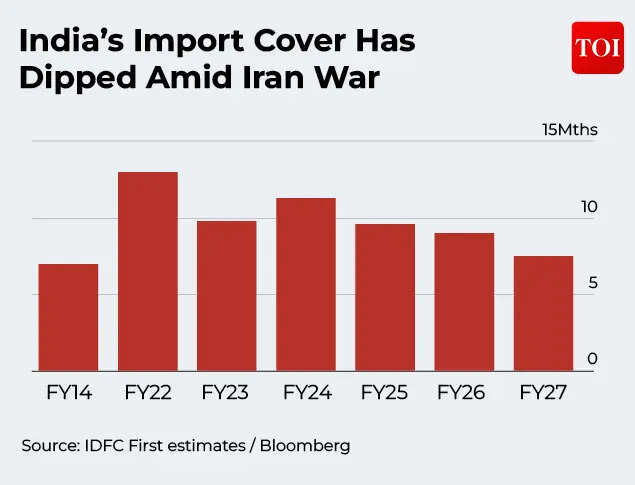
India is also expected to face a shortfall in foreign inflows for a third straight year while trying to finance a widening current account deficit amid persistently high crude oil prices.According to Gaura Sen Gupta, an extended conflict in West Asia could reduce the comfort level surrounding India’s forex reserves, but the current situation remains less severe than the taper tantrum period. She noted that India is in a stronger position now than it was in 2013, particularly in terms of capital inflows and the ratio of short-term external debt to reserves.Also Read | PM Modi wants Indians to cut gold buying: How much forex can be saved?During the 2013 taper tantrum, India’s import cover — a key indicator showing how many months of imports can be financed using existing reserves — had fallen below seven months. At present, after accounting for the central bank’s future dollar liabilities, import cover stands at nearly nine months and is projected by IDFC First Bank to slip below eight months by March 2027.Anubhuti Sahay, head of India economic research at Standard Chartered has said that the benchmark for evaluating the adequacy of India’s forex reserves is likely to be higher during the current episode compared with earlier crises, even if crude oil prices remain at similar levels, because capital inflows have weakened.Even so, India is confronting the present global uncertainty from a relatively stronger macroeconomic position, supported by manageable fiscal and external deficits along with subdued inflationary pressures.According to Madhavi Arora, chief economist at Emkay Global Financial Services, most indicators used to assess the adequacy of foreign-exchange reserves continue to show that India remains in a comfortable position. She added that the country is far removed from the conditions witnessed during the 2013 taper tantrum, noting that policymakers have since worked to maintain healthier internal and external balance sheets for the economy.
