
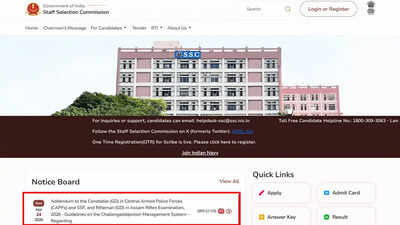
SSC CBE answer key objections: The Staff Selection Commission has issued detailed guidelines on the challenge and objection management system for computer-based examinations with objective multiple choice questions. The framework applies to the Constable (GD) recruitment in Central Armed Police Forces, SSF, and Rifleman (GD) posts in Assam Rifles Examination, 2026.Candidates have been directed to refer to the provisions outlined in the examination notice published earlier, alongside the newly released instructions. The Commission stated that the updated system aims to ensure clarity and uniformity in handling objections raised against tentative answer keys.Process for raising objections and expert reviewAfter the completion of examinations, tentative answer keys are published and candidates are invited to submit objections. These challenges are reviewed by Subject Matter Experts, whose recommendations form the basis for final answer keys. The Commission confirmed that the revised process follows feedback received through representations, RTI applications, and cases raised before courts, including observations made by the Delhi High Court.Scenarios for disputed questions explainedThe guidelines specify outcomes for different situations. If a question is found ambiguous, incorrect, or lacking a valid option, it will be discarded and marks awarded to all candidates. Where multiple correct answers exist, full marks will be granted to candidates selecting any correct option, while incorrect responses attract negative marking.In cases where a question is deemed out of syllabus, it will also be removed, with marks credited to all candidates. The Commission noted that such instances are expected to be rare due to broadly defined syllabi.Language errors and evaluation criteriaThe system also addresses translation and language-specific errors. Candidates select their examination language during application and can view questions in multiple languages, but must answer in the chosen medium. If discrepancies arise in a particular language, evaluation is carried out independently for that version.The Commission clarified that only substantive objections affecting clarity or intent will be considered. Minor errors that do not alter meaning will be disregarded. It added that the number of objections does not influence outcomes, emphasising that decisions rely solely on merit as determined by experts.The guidelines will apply to all relevant examinations from the 2026 cycle onwards.
