
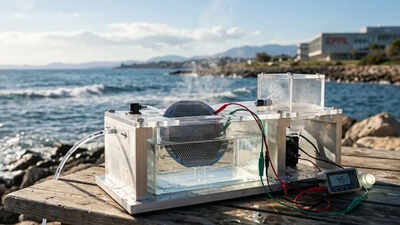
In a quest for a truly self-sustainable source of power, EPFL scientists have explored the hydrovoltaic effect, which makes electricity through the evaporation of water. Through careful engineering of a silicon-based nano-generator, researchers were able to harvest energy from the natural evaporation of seawater to generate electrical power. Unlike existing renewable resources, this innovation can continuously produce electricity through a liquid-gas interface. Using an arrangement of silicon nanopillars calibrated for both ion movement and surface charge mechanisms, an energy output five times larger was generated. This technological advancement is a new avenue in modular energy harvesting, which could soon provide power to IoT devices and wearable technology.
Nanogenerator that produces continuous electricity from evaporation
The foundation of this development is the hydrovoltaic effect, the phenomenon that is produced when liquid flows over charged nanostructures, producing power. According to the journal published in Nature Communications, the team of Laboratory of Nanoscience for Energy Technologies (LNET) found a way to manage the flow of ions in an evaporative process by introducing a silicon semiconductor coupled to an array of hexagonally patterned nanopillars. The three-layered design that decouples evaporation, ion transport, and charge collection, the authors found a way to create usable power by passing seawater through the nanostructures. It seems the heat and light induce surface charge effects, heat and light enhance the semiconductor’s surface charge density, and thus significantly increase its efficiency.
Battery-free sensors for the open ocean
The one barrier that plagues any device working in the ocean is the saltiness of the water and the corrosive nature that goes along with it. In order to make these devices more practical and capable of working in a marine environment for a substantial amount of time, the EPFL team have placed a protective oxide layer on their silicon nanopillars that will help to stop unwanted chemical reactions between the electronics and salty seawater, which will deteriorate typical electronic devices. Durability will be important when we are looking at battery-free, low-power sensor networks out in the field.
How hydrovoltaic energy could change connectivity
This technology could go much further than simply being a lab demonstration. Since a usable electric field can be generated by this device as long as there is evaporation, and it needs no external power source, relying solely on ambient heat and light, this system seems perfect for the IoT, as noted in the journal published in Nature Communications. Low-power, battery-free sensor networks, as well as potentially futuristic wearable technology, will not be tethered to conventional batteries anymore.
